
Picture this: A mother in a remote Kenyan village cradles her feverish child. The nearest hospital is hours away, and the local clinic lacks diagnostic tools. A decade ago, this story might have ended in tragedy. Today, AI steps in as an unlikely hero.
Welcome to Kenya’s healthcare revolution-where artificial intelligence isn’t just a buzzword. It’s a lifeline.
The Rural Healthcare Crisis: Why AI Matters
Kenya’s rural areas face a perfect storm:
1 doctor per 5,000 patients (WHO recommends 1:1,000). 10% of clinics have basic diagnostic tools. 3-hour treks to the nearest hospital for many. But AI is flipping the script. Let’s unpack how.
AI’s Superpowers in Rural Kenya
- “How is AI improving access to healthcare in rural Africa?”
Imagine a virtual doctor in your pocket. AI-powered telemedicine platforms like Zuri Health and Ilara Health connect patients to doctors via smartphones. No roads? No problem.
Telehealth triage: AI chatbots assess symptoms, prioritize emergencies, and route cases to human doctors. Remote diagnostics: Portable AI devices (e.g., Butterfly iQ) analyze blood samples or ultrasounds on-site.
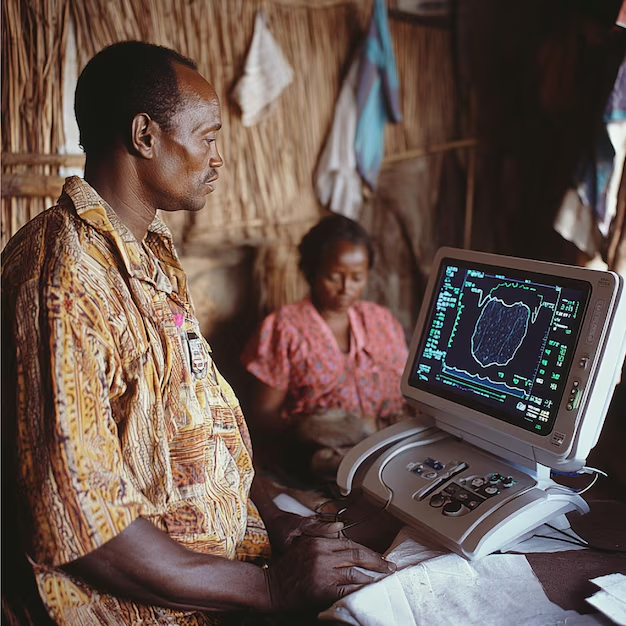
Real impact: In Busia County, teleconsultations reduced maternal mortality by 27% in 2024.
- “Which diseases is AI diagnosing effectively?”
AI isn’t playing games-it’s beating humans at spotting diseases:
Disease AI Accuracy Human Accuracy Tool Used
Tuberculosis 98% 75% CAD4TB
Pneumonia 94% 68% NeuralSight
Malaria 91% 82% AI Microscopy
Fun fact: Kenya’s Neural Labs Africa slashed TB detection time from days to 15 minutes using AI.
- “Can AI fix our doctor shortage?”
Kenya has 200 radiologists for 55 million people. AI isn’t replacing doctors-it’s making them superheroes:
AI assistants: Tools like IBM Watson analyze X-rays, freeing doctors to focus on complex cases. Training: Apps like SwipeRx upskill pharmacists via AI-driven modules. Dr. Wairimu’s story: “I used to read 100 scans daily. Now, AI flags emergencies, so I save lives instead of drowning in paperwork.”
- “What about drug shortages?”
AI isn’t just smart-it’s a supply chain wizard:
Predictive ordering: mPharma uses AI to stock clinics before disease outbreaks hit. Fake drug busting: Sproxil AI scans medication packaging to detect counterfeits. Result: Nakuru County cut drug stockouts by 40% in 2024. The Flip Side: Challenges & Solutions
“What’s stopping AI from working everywhere?” Power cuts: Solar-powered AI kits (like Zindi’s solutions) are bridging the gap. Internet gaps: Offline AI models on USB drives (yes, it’s a thing!). Pro tip: Kenya’s NOFBI fiber network is connecting rural clinics-slowly but surely.
Your Turn: Be Part of the Change
AI isn’t magic-it’s a tool. And tools need hands to wield them. Here’s how YOU can help: Spread the word: Share this article with #KenyaHealthTech. Support local startups: Follow Afya Rekod and DawaSoft. Demand policies: Push MPs to fund AI clinics in your county.
Final Thought
In 2010, Kenya leapfrogged banks with M-Pesa. In 2025, we’re leapfrogging healthcare with AI. The future isn’t just coming-it’s already here, one algorithm at a time.
What’s your AI healthcare story? Drop a comment below-we’re all ears!